
During the past couple of years the all-electric Mercedes-Benz eEconic specialised waste truck has been quietly (pun intended) assessed as a practical zero emission vehicle suited to urban waste collection and management.
Waste collection is an ideal application for a near-silent electric truck, and multiple units have undergone extensive assessment duties in Australia with an additional truck undertaking similar validation trials in New Zealand. Production versions of the eEconic are now available for sale.
The diesel-powered Mercedes-Benz Econic was engineered from the ground up to be a specialist vehicle for the growing waste and recycling space and subsequently has lent itself very well as the basis to provide an electric alternative in a 6×2 configuration. Like its internal combustion engine stablemate, the eEconic is designed to suit waste collection duty in densely populated areas and replicates many of the Econic’s features including excellent visibility and an extensive suite of active safety systems.
The Mercedes-Benz eEconic shares the same electrical architecture as the Mercedes-Benz eActros e300 which has been operating in Europe since 2018 and is now regarded as a proven and mature technology. In this waste collection vehicle application, the eEconic has a claimed range of 100-150 kilometres between battery charges, while also operating the rear body, which should prove practical to suit the average distance travelled during a typical shift on urban waste collection duty.
The eEconic uses the same eAxle design as the eActros with two integrated liquid-cooled electric motors and a two-speed automated planetary transmission, all mounted to the same rear axle “banjo” housing but without the mechanicals such as the crown wheel and pinion gears. Maximum power is 536hp (400kW) peak performance and 443hp (330kW) available as continuous output. This compares more than favorably with the diesel engine’s 272hp (200kW).
The hydraulics for the operation of the waste collection and compacting equipment are powered from an “ePTO” which can handle 30kW continuous power and up to 52kW peak power demand such as when the compactor is operating.
Three thermally controlled lithium-ion battery packs feature a 336kWh capacity. The battery packs are mounted low on the chassis to provide plenty of space for the waste compactor body and also to maintain a low centre of gravity which will enhance vehicle stability in support of the Electronic Vehicle Stability control system.
The eEconic rides on air suspension front and rear which provides the ability to adjust ride height from the cab. The battery packs have strong protection panels to minimize damage from any side impacts.
Typically the batteries will be conventionally charged overnight, but should a mid-shift top up be needed, charging from 20-80 per cent takes just 75 minutes with a 160kW charger. The eAxle frees up space at the front of the chassis where the conventional diesel engine is located on the Econic.
This space is utilised for the battery thermal management components, power steering, HVAC and compressed air. The electric drivetrain enables a level cab floor to be used, with only two entry steps for access and allowing easy movement through the cab. This is particularly advantageous when the driver wishes to enter or leave the vehicle through the folding concertina door on the kerb side, well out of the way of traffic.
In common with many electric commercial vehicles (and the current crop of F1 cars) the eEconic features regenerative braking which harnesses kinetic energy when the truck is slowing to not only act like an engine brake and assist in slowing the vehicle, but also recoup some of the energy and use that to contribute to charging the batteries with the secondary benefit of reducing wear on service brake components.
To create the initial local assessment vehicles, Daimler Trucks have worked with several waste compactor builders and the rear loader has come from Bucher Municipal, with side loader configurations set to follow. With the Bucher Municipal compactor fitted the eEconic has a tare weight of 13.9 tonnes.
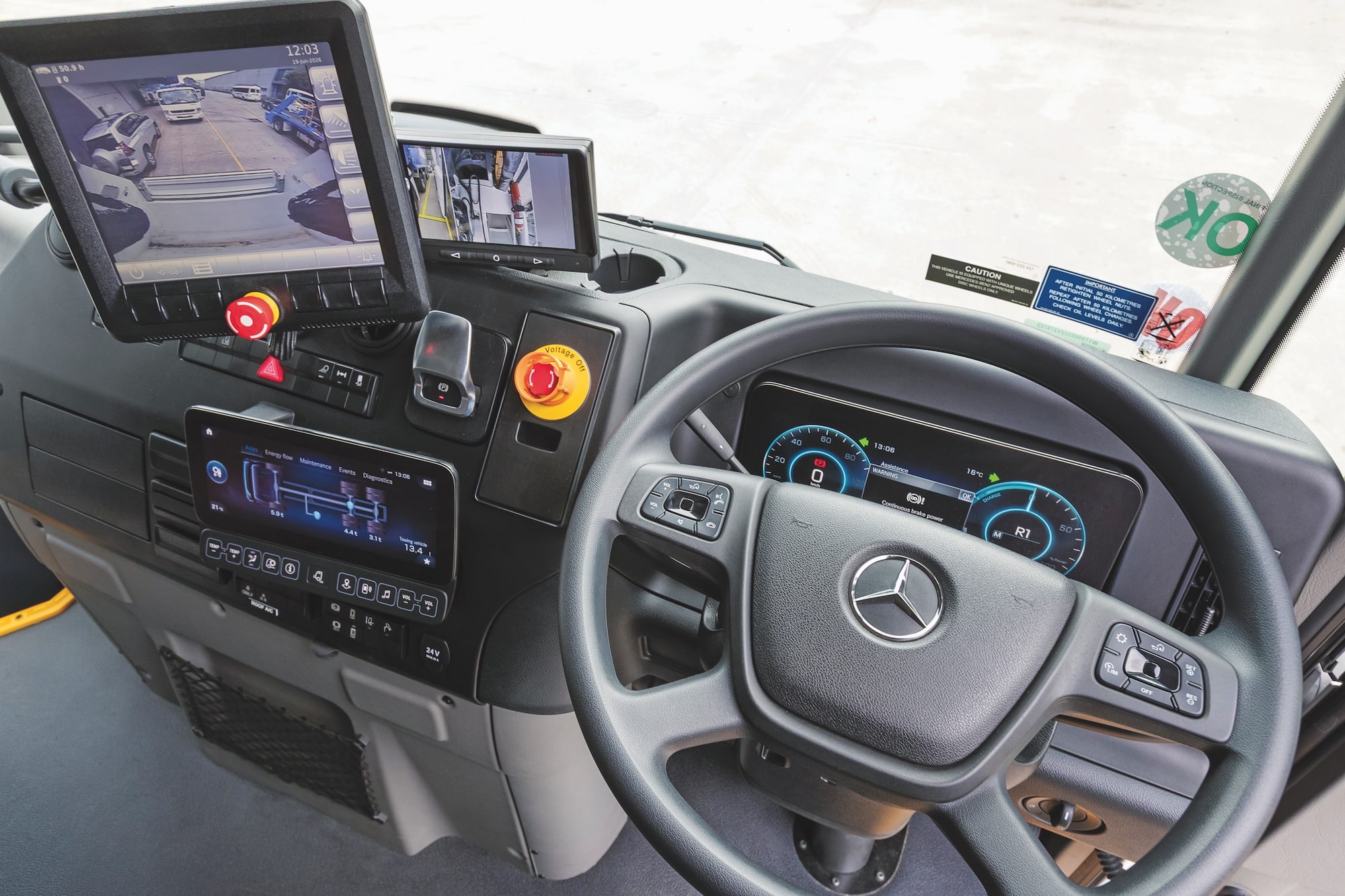
In addition to sharing much of the eActros’s electro-mechanical components, the eEconic features the same safety technology as the eActros, which is especially important given the urban environments in which it is likely to operate.
The low cab and very large windscreen help create a safer situation where the driver is at eye level with pedestrians and cyclists. The eEconic not only produces no local exhaust emissions but also operates in near silence. Mercedes-Benz claim a 10dB noise reduction in the cabin compared to the noise levels encountered by a diesel version, which is an approximate halving of the perceptible in-cabin noise volume.
Exterior noise levels are also significantly reduced and in keeping with this very quiet operation of the eEconic, it is equipped with a pedestrian alert feature known as the Acoustic Vehicle Alert System which sounds an electronic alarm when the vehicle travels at speeds up to 20 km/h in order to make other road users aware of the vehicle.
The comprehensive list of active safety features includes Active Brake Assist 6 Plus with Pedestrian Detection which can detect potential collisions and, at speeds up to 60 km/h, respond to moving pedestrians and cyclists with an automated full braking response. The system is based on camera technology plus additional radar sensors located on the headlamps and to the side and can issue a three-stage warning when danger is detected. The system uses the radar and camera of the AEBS Advanced Emergency Braking System.
The eEconic also features the Side Guard Assist 2 warning system to detect cyclists, moving pedestrians and cars when the truck is making a left turn. Other features include Proximity Control and tyre pressure monitoring.
The eEconic’s production is another major step in Daimler Truck’s path to CO2-neutral transport. The group aims to sell only CO2-neutral vehicles in its biggest sales regions of North America, Europe and Japan from 2039 forward.
Story with thanks to Prime Mover Magazine


24/7 Emergency Roadside Assistance:
Trucks: 1800 033 557